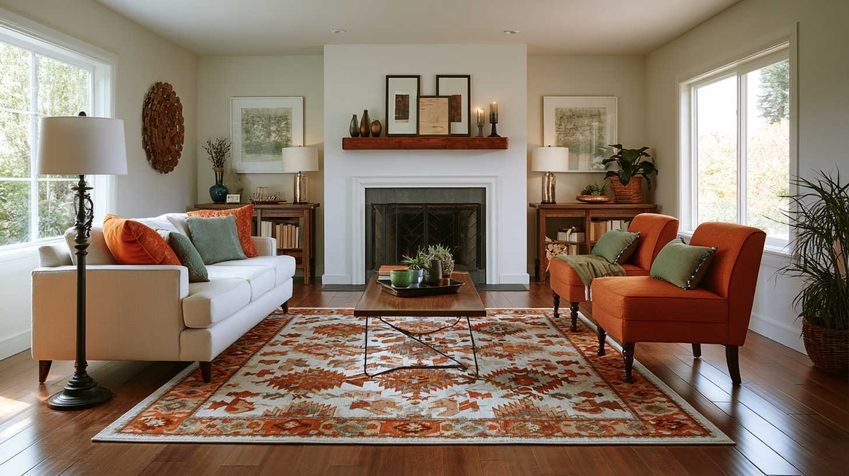
To find the right rug size for an odd-shaped room, stop measuring the walls and start measuring the zones. Split the room into simple rectangles or circles based on where furniture sits and where people walk. Size each rug to its zone, then leave a clear border of bare floor around it.
This guide covers the method step by step. It also gives standard rug sizes, clearance rules, shape strategies for L-shaped, narrow and angled rooms, and realistic price ranges.
Why Odd Rooms Break the Usual Rug Rules
Standard advice such as “buy an 8×10 for the living room” assumes a four-walled rectangle with furniture pushed to the edges. Odd rooms rarely cooperate. Common examples include:
- L-shaped rooms, where a living area and dining area share one open floor plan
- Narrow galley rooms, where length is far greater than width
- Rooms with bay windows, alcoves or nooks
- Angled or sloped-wall attic rooms
- Open-plan spaces with no walls to define zones
If you size a rug to the room’s outline, you end up with awkward gaps, a rug that looks too small, or one that runs into a doorway or radiator. Sizing to how you use the space gives a layout that looks planned, even when the floor plan isn’t.
Step 1: Think in Zones, Not Walls
Designers start by dividing an odd room into functional zones. A zone is any area where furniture groups together or where people regularly stand or walk.
Typical zones include:
- A seating group (sofa, armchairs, coffee table)
- A dining set
- A reading nook or window seat
- A bed area
- A workspace or desk
- An entry or transition path
Sketch the room on paper and draw a loose rectangle around each zone. Ignore the perimeter entirely at this stage. Whatever the walls do, your furniture groups are the real layout.
Step 2: Decide What Each Zone Needs From a Rug
Before choosing a size, decide how each zone is used, because that drives both size and material.
- High-traffic zones (entry paths, walkways) need durable, low-pile or flatweave rugs.
- Seating zones can take more texture and a higher pile for comfort.
- Dining zones need flatweave or low pile so chairs slide easily and crumbs don’t sink in.
- Homes with kids or pets need stain-resistant, washable or synthetic fibres.
- Pass-through areas that only connect two spaces may not need a rug at all.
Being honest about which parts of an odd room are “working” space and which are just architectural leftovers keeps you from overspending on rug you don’t need.
Step 3: Measure the Zones
Measure each zone as a simple shape.
- Measure the furniture group. For a sofa and chairs, measure from the outer edge of the seating on one side to the other, and from the back of the sofa to the front of the coffee table.
- Add pull-out space. For dining zones, measure the table plus at least 24 inches (60 cm) on each side so chairs stay on the rug when pulled out.
- Mark it on the floor. Use painter’s tape to outline the rug you’re considering. Walk around it and look at it from the doorway.
- Check clearances. Confirm the rug won’t clash with door swings, radiators, floor vents or cabinet doors.
- Record the final size as length x width, in both feet and centimetres if you’re shopping across regions.
Step 4: Use the Right Border Rules
A rug should never look like wall-to-wall carpet. Bare floor around the edge frames the rug and makes the room look larger. These clearances hold up across most layouts:
| Room type | Recommended gap between rug and wall | Notes |
|---|---|---|
| Living room | 8-18 in (20-45 cm) | Larger rooms can take the wider gap |
| Dining room | 12 in (30 cm) minimum | Table edge to rug edge: 24-36 in (60-90 cm) |
| Bedroom | 12-24 in (30-60 cm) | 24 in of rug visible on both sides and foot of bed |
| Narrow or tight room | 6 in (15 cm) | A smaller border prevents a cramped look |
| Hallway with runner | 3-6 in (8-15 cm) | Runner should not span the full length |
In odd rooms, apply these gaps to the walls that border your zone. A zone that borders open floor, such as an open-plan seating area, doesn’t need a wall gap. Instead, leave a clear walkway of 30-36 inches (75-90 cm) between the rug edge and neighbouring furniture.
Standard Rug Sizes and Where They Work
Knowing the standard sizes helps you tell when a zone fits a ready-made rug and when it needs something custom.
| Rug size (ft) | Metric (cm) | Best for | Approx. price range (USD)* |
|---|---|---|---|
| 2×3 | 60×90 | Entry, sink, small nook | $15-$80 |
| 3×5 | 90×150 | Bedside, reading corner | $30-$150 |
| 5×7 | 150×210 | Small seating area, home office | $80-$400 |
| 6×9 | 180×270 | Bedroom (full bed), mid-size seating | $150-$700 |
| 8×10 | 240×300 | Living room, queen bed | $250-$1,200 |
| 9×12 | 270×360 | Large living or dining, king bed | $350-$1,800 |
| 2.5×8 to 3×10 | 75×240 to 90×300 | Hallway runner | $40-$400 |
| 5 ft round | 150 | Nook, entry, small dining | $60-$350 |
| 8 ft round | 240 | Round table, corner seating | $200-$900 |
*Prices are typical retail ranges and vary widely by material, construction and brand. Natural fibres like jute and sisal, and synthetics like polypropylene, sit at the lower end. Hand-knotted wool and vintage pieces sit at the higher end.
Shape Strategies for Common Odd Rooms
L-Shaped Rooms
The L-shape is the classic odd room. Treat each arm of the L as its own room.
- Use two rugs, one per zone, that share a color or texture so the space feels connected.
- Keep a consistent border to the walls on each side.
- Avoid placing a rug across the inner corner of the L unless you order a custom L-shaped piece.
Narrow Galley Rooms
In a long, thin room, one giant rug pulls the eye down a tunnel. Instead:
- Use two zone rugs oriented across the room’s width, or a large rug in the widest section.
- Choose horizontal stripes or patterns that widen the space visually.
- Use a runner only where the space is truly corridor-like.
Rooms With Bay Windows or Alcoves
- A round rug under a small table in a bay repeats the curve of the window.
- Use a half-moon rug for a curved alcove or against a straight wall.
- Leave the alcove floor bare if the window seat or built-in makes it a separate zone.
Angled or Sloped-Wall Rooms
- Keep rugs rectangular and centred on furniture, not aligned to the angled wall. Aligning to an angle usually looks like a mistake.
- Keep the rug clear of the low sloped edge where you can’t walk anyway.
Open-Plan Spaces
- Define each zone with its own rug, sized so the furniture in that zone is at least half on the rug.
- Vary the pattern, but keep colors related so the rugs read as a set.
Rug Shape Comparison for Odd Rooms
| Shape | Best fit | Watch out for |
|---|---|---|
| Rectangle | Seating groups, beds, most zones | Can look rigid in curved spaces |
| Round | Bays, entry, round tables | Wastes floor in square nooks |
| Runner | Narrow corridors, galley kitchens | Too short a runner looks like a mat |
| Half-moon | Alcoves, doors, against walls | Limited size range |
| Asymmetric or freeform | Angled walls, modern layouts | Harder to find, often pricier |
| Custom L or cut-to-size | Unusual footprints | Longer lead time, higher cost |
When to Order a Custom Rug
Ready-made sizes work when a zone fits a standard rectangle with a proper border. Consider custom sizing when:
- The zone is L-shaped or curved and no standard shape matches
- You need a size between two standards, such as 7×10 or 10×14
- A rug has to fit around a fireplace hearth, stairs or built-in cabinet
- You want an exact colour, pile height or edge finish
Typical custom pricing: Machine-made custom rugs in wool or synthetics often start around $10-$40 per square foot. Hand-knotted or hand-tufted custom pieces run roughly $30-$150+ per square foot. A 9×12 custom wool rug can therefore range from about $1,100 to $4,000 or more depending on construction. Lead times are commonly several weeks.
Ask about sample swatches before you commit. Colour and pile look very different in your lighting than on a screen.
Layering: The Budget Fix for Awkward Spaces
If no single rug fits, layering solves it cheaply.
- Choose a large, neutral base such as jute or sisal in a standard size like 8×10 or 9×12. Natural fibres are usually the most affordable big rugs.
- Place a smaller, patterned rug on top, angled slightly or centred on the seating area.
- Keep the base rug visible on at least two sides so the layering looks deliberate.
Layering also rescues a rug you love that’s too small. Anchor it to the room with a large base and it will look intentional.
Furniture Placement Rules for Any Rug
Consistency matters more than a fixed formula. Use one of these three approaches per zone:
| Approach | Rule | Best for |
|---|---|---|
| All legs on | Rug extends past all furniture legs | Large rooms, floating layouts |
| Front legs on | Front legs of sofa and chairs sit on rug, back legs off | Most medium rooms |
| All legs off | Rug sits in front of the furniture | Very small rooms, wall-backed sofas |
Don’t mix approaches inside the same zone. A sofa fully on the rug with the chairs fully off looks accidental.
Bedroom Rug Sizes (Quick Reference)
Bedrooms are usually simpler than living areas, but odd layouts such as beds under slopes or off-centre still need care.
| Bed size | Recommended rug | Result |
|---|---|---|
| Twin | 5×8 | Rug visible on both sides |
| Full | 6×9 | Foot and sides covered |
| Queen | 8×10 | 24 in visible on three sides |
| King | 9×12 | Full coverage, balanced margins |
If the bed sits in an alcove or under a slope, consider two runners along the sides or one rug that starts at the bed’s mid-length and extends to the foot.
Choosing Materials for High-Use Zones
| Material | Durability | Cleaning | Typical price per sq ft |
|---|---|---|---|
| Polypropylene | High | Easy, water-resistant | $2-$8 |
| Jute | Medium | Spot clean only | $3-$10 |
| Sisal | High | Dry clean, avoid moisture | $4-$12 |
| Wool | High, resilient | Professional cleaning | $8-$40 |
| Cotton flatweave | Medium | Often machine washable | $3-$12 |
| Viscose | Low | Very hard to clean | $6-$20 |
For dining zones, choose flatweave or low pile in polypropylene, wool or cotton. For entries and hallways, use polypropylene or a tight wool weave. Avoid shag in any area where you eat.
Common Mistakes to Avoid
- Buying too small. An undersized rug makes the room look chopped up. If budget is tight, go one size up in an inexpensive fibre.
- Sizing to the wall shape. Follow furniture, not walls.
- Ignoring door swings. Check clearance for every door, cabinet and drawer, including thick-pile rugs.
- Forgetting a rug pad. A pad prevents slipping, protects the floor and adds cushion. Expect roughly $20-$100 depending on size.
- Mixing furniture placement rules. Keep it consistent within each zone.
- Skipping the tape test. Tape the outline for a day and walk around it before ordering.
Quick Decision Checklist
- I have divided the room into zones.
- I know the traffic path through each zone.
- I have taped out the rug size on the floor.
- I have a 6-18 inch border where the rug meets walls.
- Furniture placement is consistent in each zone.
- I have checked door and drawer clearance.
- I have compared standard, layered and custom options.
- I have ordered a sample or swatch first.
FAQ: Rug Sizes for Odd-Shaped Rooms
Use two rugs, one for each arm of the L. Size each to its furniture group, such as an 8×10 for the living area and a 5×7 or round rug for the dining or reading area. Keep colours related.
Yes. Round rugs work well under round tables and in entries, nooks or bay windows. In a seating area, a round rug is best when the furniture is arranged in a circle or around a round coffee table.
Aim for 8-18 inches (20-45 cm) in most rooms. In narrow or tight rooms, 6 inches (15 cm) keeps the space from feeling cramped.
Too small is the more common and more visible mistake. If unsure, choose the larger size, as long as you can still keep a border of bare floor.
When no standard shape fits, custom sizing avoids awkward gaps and looks more intentional. If budget matters, layering a smaller rug over a large neutral natural-fibre base gets close for far less money.
Use a rug pad cut about 1 inch smaller than the rug on every side. Choose a felt-and-rubber pad for hard floors and a thinner, grippier pad for carpet.
Final Takeaway
Odd rooms stop being difficult once you stop fighting the walls. Break the space into zones, measure furniture groups as simple shapes, leave clear borders, and pick the right size, shape or layering approach for each. Use a standard rug where a zone fits one, and go custom only where the layout demands it.
Happy Designing!
Share How Do You Find the Right Rug Size for Odd Rooms? with your friends and leave a comment below with your thoughts.
Read Should Curtains Match Walls, or Does That Look Flat? until we meet in the next article.
1 thought on “How Do You Find the Right Rug Size for Odd Rooms?”