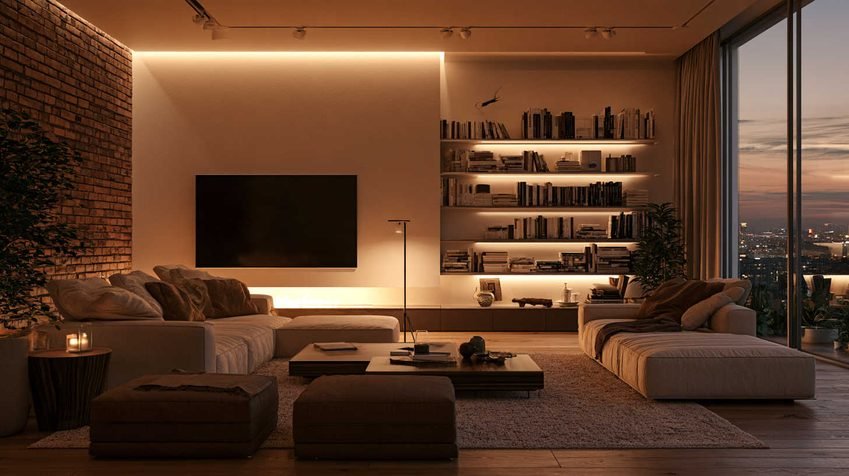
Yes — mixing warm and cool lighting in the same room works well, and in most modern homes it’s actually the smarter design choice, not a mistake to avoid. The key is separating light by function, keeping color temperatures close enough to feel intentional, and never letting warm and cool bulbs clash on the same fixture or wall. Done right, this approach gives you a space that feels cozy where you relax and sharp where you need to focus — without looking mismatched or accidental.
This guide breaks down exactly how color temperature works, which combinations succeed, which ones to avoid, and how to apply the right mix room by room.
Understanding Color Temperature: The Kelvin Scale
Every light bulb has a color temperature measured in Kelvin (K). This number tells you how “warm” (yellow-orange) or “cool” (blue-white) the light appears — it has nothing to do with the physical heat of the bulb.
| Kelvin Range | Light Appearance | Typical Feel | Best Use |
|---|---|---|---|
| 2200K–2700K | Warm amber/yellow | Cozy, intimate | Bedrooms, living rooms, dining |
| 2700K–3000K | Soft white | Relaxed, comfortable | General ambient lighting |
| 3000K–3500K | Neutral white | Balanced, transitional | Hallways, entryways |
| 3500K–4100K | Cool white | Clean, functional | Kitchens, home offices |
| 5000K–6500K | Daylight | Crisp, energizing | Bathrooms, garages, workshops |
Lower numbers produce a yellow-orange glow because they emit more light at the red end of the visible spectrum. Higher numbers push toward blue-white because they emit more short-wavelength light — the same physics that makes midday sun look “cooler” than a sunset.
Why Mixing Lighting Works (When Done Correctly)
A single-temperature home often feels flat. All-warm lighting throughout can make workspaces feel sleepy and reduce visual clarity for tasks like cooking or reading fine print. All-cool lighting, on the other hand, can make a home feel clinical, sterile, or uninviting — more like an office than a place to unwind.
Mixing temperatures by zone solves both problems. It lets each part of a room do its job: warm light signals “relax here,” while cool light signals “focus here.” This is the same principle professional interior lighting designers use when layering ambient, task, and accent lighting.
The Three Golden Rules of Mixing Light Temperatures
1. Match Light to Function, Not Just Aesthetics
Cool light (3500K–4500K) suits areas where visual precision matters — kitchen counters, bathroom vanities, home office desks. Warm light (2700K–3000K) suits areas meant for winding down — sofas, bedrooms, dining tables. Choose the Kelvin rating based on what the space is for, then let the aesthetic follow.
2. Never Mix Temperatures on the Same Fixture or Surface
Putting a warm bulb and a cool bulb in the same multi-bulb fixture, or placing two different-temperature fixtures directly next to each other on one wall, creates a visible, distracting clash. The eye reads this as a mistake rather than a design choice. Keep each fixture — and each contiguous surface — on a single temperature.
3. Keep Adjacent Zones Within a Reasonable Kelvin Gap
Jumping from 2700K straight to 6500K in adjoining spaces is jarring. A gap of 1,000K–1,500K between neighboring zones (for example, 2700K in a living room next to 4000K in an open kitchen) reads as intentional layering. A gap of 3,000K+ often reads as a lighting error.
Room-by-Room Lighting Guide
Living Room: Balanced and Inviting
Use warm ambient light (2700K) in ceiling fixtures, wall sconces, or floor lamps to create a soft, welcoming base layer. Add cooler accent lighting (3500K–4000K) only in functional pockets — a reading chair, a bookshelf, or a media console — to add contrast and definition without overwhelming the room’s mood.
Bedroom: Comfort Over Clarity
Warm light (2200K–2700K) should dominate bedrooms since the goal is rest, not alertness. Bedside lamps and cove or indirect lighting work well here. If the room doubles as a home office or has a vanity mirror, add a single cool-toned task lamp (4000K) aimed directly at that work surface, isolated from the rest of the room’s warm glow.
Kitchen: Clarity Meets Warmth
Kitchens need bright, accurate light for food prep and safety. Cool white (4000K–5000K) under-cabinet or over-counter lighting ensures true color rendering while chopping, reading labels, or checking food doneness. Pair this with warmer overhead or pendant lighting (2700K–3000K) over an island or dining nook to keep the space feeling welcoming during meals rather than clinical.
Bathroom: Fresh but Relaxing
Cool white (4000K–5000K) around the vanity mirror is essential for grooming tasks like shaving or makeup application, since it renders skin tone and color accurately. Warmer accent lighting (2700K) near a bathtub or shower area can shift the mood toward spa-like relaxation in the evening.
Dining Area: Warm Glow with Subtle Contrast
Pendant lamps or chandeliers in the 2700K–3000K range enhance food presentation and create intimacy at the table. For a modern layered look, add dimmable cool-white strip lighting along a nearby buffet, shelf, or backsplash to introduce depth without disrupting the table’s warm centerpiece lighting.
Comparison Table: Warm vs. Cool Lighting
| Factor | Warm Light (2700K–3000K) | Cool Light (4000K–6500K) |
|---|---|---|
| Visual effect | Yellow-orange, soft glow | Blue-white, crisp glow |
| Mood created | Relaxing, cozy, intimate | Alert, energizing, clean |
| Best rooms | Bedroom, living room, dining | Kitchen, bathroom, office |
| Color rendering for tasks | Lower accuracy | Higher accuracy |
| Common bulb type | Incandescent-style LED, soft white | Daylight LED, cool white |
| Typical LED bulb price (per bulb) | $2–$8 | $2–$8 |
| Smart/tunable bulb price | $12–$50 | $12–$50 |
Note: prices vary by brand, brightness (lumens), and smart features like app control or voice integration. Tunable white smart bulbs that adjust between 2700K and 6500K on demand typically cost more upfront but remove the need to buy separate warm and cool bulbs.
Practical Tools for Getting the Mix Right
Layered lighting design. Combine three layers in every room: ambient (general fill light), task (focused light for specific activities), and accent (decorative highlighting). Assign warm or cool temperatures to each layer based on its purpose rather than applying one temperature to the whole room.
Dimmers and smart controls. Dimmer switches let you soften a cool light’s intensity in the evening, while smart bulbs with tunable white technology let a single fixture shift from 2700K in the morning to 4000K during work hours automatically. This is especially useful in multi-purpose rooms like a kitchen-dining combo or a bedroom-office.
Transitional temperatures. When two zones with different temperatures sit close together, a neutral white fixture (3000K–3500K) placed between them — in a hallway, archway, or open shelving unit — smooths the visual transition instead of creating a hard line between warm and cool.
Surface and material awareness. Glossy, reflective surfaces (polished tile, glass, chrome fixtures) amplify cool light and can make a space feel colder than intended. Matte finishes and wood tones absorb and soften light, enhancing warmth. Factor your existing finishes into your Kelvin choices before buying bulbs.
Common Mistakes to Avoid
- Mixing temperatures within one multi-bulb fixture. Even if each bulb works fine individually, side-by-side warm and cool bulbs in the same lamp or chandelier create a visibly uneven, “mismatched” look.
- Ignoring color temperature when buying replacement bulbs. A burned-out 2700K bulb replaced with a 5000K bulb in the same fixture creates an obvious mismatch, even if the wattage and shape are identical.
- Overcorrecting with extreme contrast. Pairing very warm (2200K) and very cool (6500K) light in adjoining, visible spaces tends to look like a lighting error rather than a design decision — keep transitions gradual.
- Forgetting about natural light. A room with large windows facing north tends to receive cooler daylight, while south-facing rooms get warmer daylight. Account for how daylight interacts with your artificial lighting choices throughout the day.
- Skipping a lighting plan for open-concept spaces. In open floor plans, kitchen, living, and dining areas are visually connected. Without deliberate zoning, warm and cool fixtures across the open space can clash more noticeably than in separated rooms.
Quick Reference: Kelvin by Room
| Room | Recommended Kelvin | Notes |
|---|---|---|
| Bedroom | 2200K–2700K | Add 4000K task lamp only if used as office |
| Living Room | 2700K–3000K | Add 3500K accent near reading/work nook |
| Kitchen | 3500K–4500K | Warmer pendant (2700K) over island optional |
| Bathroom | 4000K–5000K | Warm accent near tub for relaxation |
| Dining Room | 2700K–3000K | Cool accent lighting for depth, optional |
| Home Office | 4000K–5000K | Reduces eye strain during screen work |
| Hallway/Entry | 3000K–3500K | Acts as a transitional buffer zone |
Final Thoughts
Mixing warm and cool lighting in one room isn’t just acceptable — it’s how professionally designed interiors achieve both comfort and functionality at the same time. The formula is simple: assign temperature by purpose, keep each fixture consistent within itself, limit the Kelvin gap between neighboring zones, and use dimmers or smart bulbs to fine-tune the balance as the day changes. A home lit entirely in one temperature will always feel one-dimensional. A thoughtfully zoned mix of warm and cool light, on the other hand, lets every room do exactly what it’s meant to do — and look intentional while doing it.
Happy Designing!
Share Can You Mix Warm and Cool Lighting in One Room? with your friends and leave a comment below with your thoughts.
Read Why Do Rooms Look Bigger in Photos Than Real Life? until we meet in the next article.